


Quick Summary
The best non-clutter gift for a minimalist parent is one with a real use, a personal touch, and minimal storage needs. Strong options include experience gifts, consumables a parent already enjoys, and durable keepsakes used every day, such as a mug, blanket, watch, or tumbler.
- Start by asking what the parent already uses, reads, drinks from, or does on weekends.
- Experience gifts leave no clutter, and a small keepsake like a journal keeps the memory tangible.
- Consumables such as good coffee or tea disappear after use, so they add nothing to the clutter pile.
- Choose practical keepsakes that will be used weekly, such as a blanket, watch, or insulated tumbler.
- Coordinate with relatives before the holiday so several small gifts do not add up to clutter.
Table of Contents
- Why Minimalist Parents Are Hard to Shop For
- Experience Gifts for Parents That Leave No Clutter
- Consumable Gifts for Parents They Will Actually Use
- Practical Gifts for Minimalist Parents That Earn Their Space
- Personalized Keepsake Gifts for Parents Without the Clutter
- Eco-Friendly Packaging and Digital Gift Options
- How to Start the Gift Conversation With Minimalist Parents
- Choosing Your Next Gift for Mom or Dad
- Frequently Asked Questions
Why Minimalist Parents Are Hard to Shop For
Minimalist parents are among the trickiest people to buy for, because the usual gift ideas work against them. Every new object adds something to dust, store, or eventually donate.
The challenge is that minimalist parents tend to say they want nothing. They may mean it, and they may still be happy to receive something that carries real meaning.
Start by asking what the parent already uses, reads, drinks from, or does on weekends.
Experience Gifts for Parents That Leave No Clutter
Experience gifts are the classic answer for parents who want less stuff. Think dinner reservations, a day trip, a class, or tickets to something they have mentioned. The gift lives in the memory, not on a shelf.
Pair an experience with a small keepsake to make it feel personal. A journal for recording shared trips is a good example.
Watch out: an experience gift only works if the parent can actually find the time. Confirm dates before you buy.
Consumable Gifts for Parents They Will Actually Use
Consumables disappear after use, so they add nothing to the clutter pile. The most useful ones are things a parent already enjoys: good coffee, tea, or a favorite treat.
A personalized mug is a practical choice, since it gets used every day.
The key is to match the consumable to a habit the parent already has. Guessing wrong makes the gift feel like one more thing to store.
Practical Gifts for Minimalist Parents That Earn Their Space
Some practical gifts are worth keeping because they replace something the parent already owns or fill a real need. The rule is simple: if it will be used weekly, it earns its place.
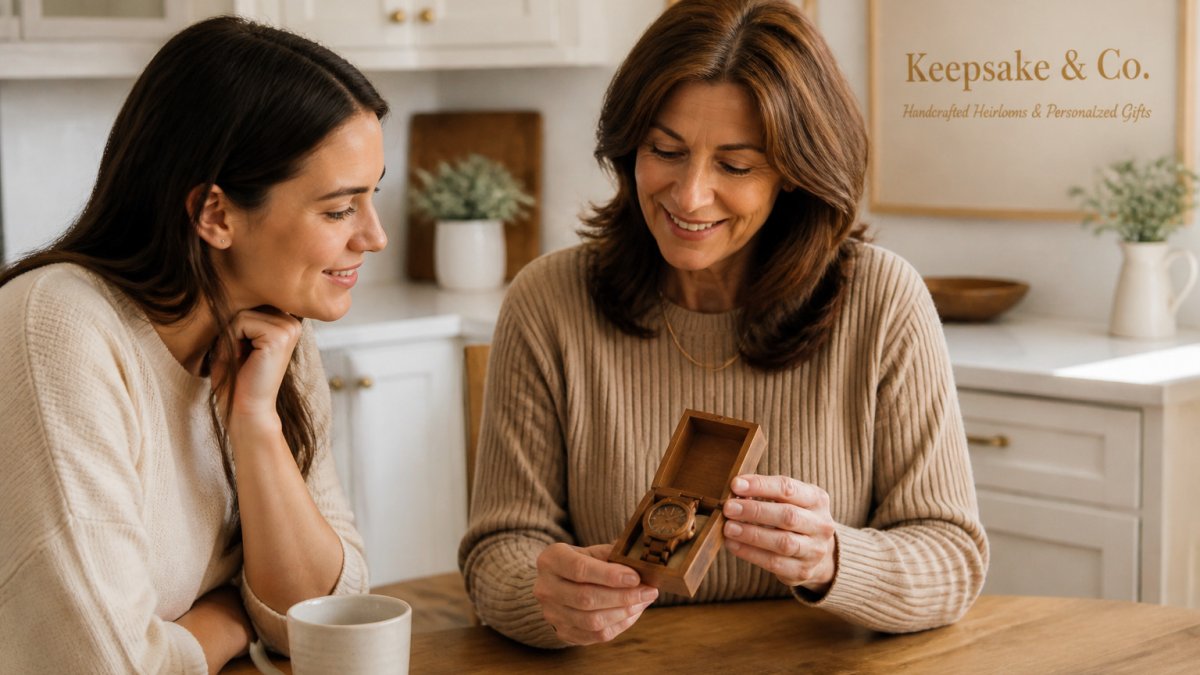
A personalized wearable is one option. The You Are My Life Wooden Watch ($79.95) features a sandalwood case, a genuine black leather band, and a Japanese quartz movement.
Avoid gadgets that need charging, updating, or a new drawer. A simple, durable item that does one job well is the minimalist standard.
Personalized Keepsake Gifts for Parents Without the Clutter
A keepsake works best when it is useful as well as sentimental. A blanket, for example, gets used every day and carries a personal design.
The Life is Better With You Heirloom Blanket ($59.99) is woven on a loom from 100% cotton yarn with colorful fringe.
Another option is the My Happy Place Tumbler ($60.99), a 40oz laser-engraved stainless steel tumbler with a spill-proof lid and reusable straw.
Here is a quick comparison of the keepsake options:
| Gift | Price | Best For | Daily Use? |
|---|---|---|---|
| Heirloom Blanket | $59.99 | Cozy evenings, memory keeping | Yes |
| Wooden Watch | $79.95 | Everyday wear, milestones | Yes |
| Happy Place Tumbler | $60.99 | Commutes, outdoor time | Yes |
| Custom Name Necklace | $39.95 | Personal, understated jewelry | Yes |
The Custom Name Necklace ($39.95) is another understated option.
Eco-Friendly Packaging and Digital Gift Options
Minimalist parents tend to care about what a gift leaves behind, not just what it adds. That makes packaging and digital delivery part of the gift itself, not an afterthought.
Zero-waste wrapping that still feels like a gift
The default wrapping paper problem is real: most glossy and metallic papers are not recyclable in curbside programs, and ribbon and bows usually are not either. A few swaps solve it without making the present look like an afterthought.
- Fabric wrap (furoshiki style). A square of cotton or linen, folded and tied, becomes part of the gift, a tea towel, a scarf, a produce bag. It is reusable, and it doubles as a second present.
- Reusable gift bags. A sturdy cloth or kraft bag gets used for years. Choose one without a plastic window or laminated finish.
- Paper you already have. Brown kraft paper, newspaper, and pages from an old atlas are all recyclable and cost nothing. A simple twine bow replaces ribbon.
- Jars and tins. Consumables like loose tea, coffee, or bath salts can go straight into a reusable glass jar with a handwritten label. The container is the wrapping.
- Skip the tissue and the box. If the item ships in its own gift box, ask the retailer to ship it without an outer gift box. Fewer layers means less to recycle.
Digital gifts that create no physical footprint
Digital delivery is the cleanest option for a minimalist parent, but the category is broader than a streaming subscription. A few that tend to get used:
- Cloud storage. A year of extra storage solves a real problem for parents whose phones are full of photos. It is invisible, it is used daily, and it replaces nothing on a shelf.
- Photo management and printing credits. A credit toward a photo book or a print service lets the parent turn a phone full of images into one keepsake, and only one.
- Audiobook and e-book credits. For a parent who reads, a credit is a consumable that never becomes a stack of paperbacks.
- Digital magazine or newspaper subscriptions. A single login replaces a pile of paper, and many services offer gift terms shorter than a full year.
- Online classes. A cooking, language, or photography class is an experience with no shipping and no storage.
- A digital gift card to a local business. It supports a shop the parent already loves and arrives by email.
The trade-off to name out loud
Digital gifts can feel impersonal if they arrive as a bare code in an inbox. Pair the code with a short note explaining why you chose it, "for the photos you keep saying you'll organize", and the gift reads as thoughtful rather than lazy. The same rule applies to experience gifts: the message is what turns a transaction into a present.
You Are My Life- Wooden Watch →
A quick packaging checklist before you order
- Does the retailer offer a plastic-free or minimal packaging option at checkout?
- Can the item ship in its own gift box, without an outer box and tissue?
- Is the wrapping reusable, fabric, a cloth bag, a jar, rather than disposable?
- If the gift is digital, is there a personal note attached?
- If the gift is an experience, is the confirmation going to the recipient's inbox or yours?
None of these steps takes more than a minute, and together they remove most of the waste a gift would otherwise create.
How to Start the Gift Conversation With Minimalist Parents
Most minimalist parents do not dislike gifts. They dislike the aftermath: the bag of things to find a home for, the guilt of donating a present someone chose with care, the slow creep of objects that were never asked for. The conversation works best when it is framed around that aftermath rather than around the gift itself.
The three-sentence framework
A script that lands well usually does three things in order: it names the relationship, it states the preference as a shared value, and it offers an easy alternative. For example:
"I love that we get to celebrate you. We're trying to keep the house lighter this year, so we'd rather put money toward something we do together than something we unwrap. Would a dinner out or a museum day work better for you?"
That structure works because it never says "don't buy me things." It says "here is what we value," which is easier for a relative to hear without feeling rejected.
Scripts for the three common situations
When you are the parent telling relatives:
"We're so grateful you want to spoil the kids.
When you are the adult child telling a parent:
"I don't need anything for the house, honestly. What I'd love is a day with you, lunch and a walk, no errands.
When a relative has already bought something:
"Thank you for thinking of us, this was so kind.
Handling the pushback
Expect three responses. The first is "but I want to give you something." Answer with a concrete alternative rather than a refusal: "Then give us an afternoon, I'll pick the place." The second is "you're so hard to shop for." Reframe it as helpful: "I know, and I'm sorry. Here are three things I'd actually use," and name specific items or experiences. The third is silence followed by a generic gift card.
Coordinate before the holiday, not after
One of the most common failure modes is five relatives each buying a "small" gift that together fill a closet. A short group message two weeks before the event solves most of it:
"Before we all shop, can we agree on one bigger thing for [parent] instead of several small ones? I'm happy to organize. Reply with a budget and I'll put together two or three options."
That message does three jobs: it sets a budget, it gives one person ownership, and it converts scattered spending into a single experience or keepsake. If the family prefers to shop separately, agree on categories instead, one person handles the experience, one handles consumables, one handles a keepsake.
When the parent is the one giving
Minimalist parents often struggle just as much on the giving side. If you are the parent, a short note in the invitation or group chat works better than a lecture: "We're keeping gifts small this year, a book, a consumable, or a shared outing is perfect. Please don't feel you need to do more." That gives guests permission to spend less, which most of them quietly want anyway.
Choosing Your Next Gift for Mom or Dad
The best non-clutter gift for a minimalist parent balances three things: a real use, a personal touch, and minimal storage. A journal, a mug, a blanket, a watch, or a custom necklace each meets those tests in a different way.
Start with the parent's daily routine, pick one of the categories above, and add a personal detail that only you could provide. A gift that reflects the relationship will matter more than one that simply takes up no space.
Frequently Asked Questions
What do you buy for parents who don't want more stuff?
Focus on gifts that are used up, shared, or experienced rather than kept. Consumables like good coffee, a shared meal, or a gift card to a restaurant they already love leave no lasting clutter. Experiences such as tickets to a concert, a day trip, or a cooking class create memories without adding objects to their home. Asking a family member what they already enjoy is often the fastest route to a gift they will appreciate.
What are good non-material gifts for parents?
Strong non-material options include experience gifts like a weekend away, a class they have mentioned wanting to take, or a guided outing. Service-based gifts such as a house cleaning session, a meal delivery subscription, or help with a home project also work well. Digital memberships, such as a streaming service or an online course, provide value without any physical footprint in the home.
How can I give a sentimental gift without adding clutter?
Choose sentimental gifts that are compact and purposeful. A personalized keepsake that they will use daily, like a wooden watch or a ceramic mug with a meaningful phrase, carries emotional weight without crowding shelves. Alternatively, a personalized item they can wear or use in routine moments keeps the gift functional. Avoid decorative items that will sit unused, since those are the pieces minimalist parents tend to pass along.
What practical gifts do minimalist parents appreciate?
Minimalist parents tend to value well-made items they will use every day. Examples include a durable journal for planning and reflection, a quality insulated tumbler for daily drinks, or a lightweight blanket for the living room. The key is choosing fewer, higher-quality pieces that replace something they already own, rather than adding an extra item to the home.


