


Last Updated: October 29, 2026
Quick Summary
The most effective ways to personalize baby keepsakes are adding a name or birth date to a blanket, plaque, or necklace, or making a hands-on piece like an air-dry clay hand or foot impression. Each option suits a different budget and level of effort, with custom products starting at $39.95.
- Heirloom Woven Blanket starts at $59.99 and is woven from 100% cotton yarn.
- Acrylic Square Plaque starts at $39.95 and includes a wooden LED base.
- Custom Name Necklace allows up to 10 characters in stainless steel or 18K yellow gold finish.
- Air-dry clay impressions should dry 24 to 72 hours, turning once a day, before sealing.
- Confirm every character before checkout, since custom items are made to order.
Table of Contents
- Why Personalized Baby Keepsakes Matter More Than Generic Gifts
- Creative Ways to Personalize Baby Keepsakes With a Name or Birth Date
- DIY Baby Keepsake Ideas for Hands-On Parents
- Baby Memory Box Ideas That Hold Everything Safely
- Handprint and Footprint Keepsakes Worth Preserving
- Personalization Ideas by Budget, Effort and Keepsake Type
- Choosing Your Next Personalized Keepsake From Keepsake & Co.
- Frequently Asked Questions
Why Personalized Baby Keepsakes Matter More Than Generic Gifts
To personalize baby keepsakes is to give parents something a generic gift never can: a piece that carries a child's own name, birth date, or handprint.
Generic gifts are easy to buy and easy to forget. A personalized piece is harder to replace, which is exactly why it tends to be kept.
The real question is not whether to personalize, but how.
Creative Ways to Personalize Baby Keepsakes With a Name or Birth Date
Adding a name or birth date is the most common starting point, and it works well because it is specific without being complicated. A name or date can appear on a blanket, a plaque, or a necklace.
Here are three options from our catalog:
- Heirloom Woven Blanket. This custom product is woven on a loom from 100% cotton yarn and transforms your image into a woven memento. It starts at $59.99.
- Acrylic Square Plaque. Printed on premium acrylic with a wooden LED base, this plaque suits a nursery shelf. It starts at $39.95.
- Custom Name Necklace. Choose up to 10 characters in polished stainless steel or 18K yellow gold finish. It starts at $39.95.
Double-check spelling before ordering, since custom items are made to order.
DIY Baby Keepsake Ideas for Hands-On Parents
Most roundups show a finished clay print and stop there. The part parents actually struggle with is the sequence: what to buy, how to keep a newborn's hand open, how long to let the piece cure, and how to seal it so it does not crumble on a shelf. The three projects below are ordered from easiest to most involved, with the concrete steps that make the difference between a keepsake and a lump of clay.
Air-Dry Clay Hand and Foot Impressions
Air-dry clay is the most forgiving option because it needs no kiln and no heat. Steps for a clean print:
- Buy the right clay. Look for a fine-grain, non-toxic air-dry clay labeled for craft use.
- Work on a nonstick surface. Roll the clay to roughly 1/2 inch thick on parchment paper or a silicone mat.
- Press, do not push. Wait until the baby is calm, fed, and warm. Press the hand or foot straight down and lift straight up. Rocking the hand sideways is what smears the print.
- Cut and pierce. Trim the edge with a plastic knife and poke a small hole near the top if you plan to hang it. Do this while the clay is still soft.
- Dry slowly. Let it air-dry for 24 to 72 hours depending on thickness and humidity, turning it once a day. Fast drying causes cracks, so keep it out of direct sun and away from vents.
- Seal it. Once fully dry, brush on two thin coats of a water-based acrylic sealer, letting each coat dry in between.
Framed Fabric From a Special Outfit
A framed piece of the coming-home outfit or a first blanket is one of the least expensive keepsakes you can make and one of the most durable if you frame it correctly.
- Choose the fabric. Pick a piece with a pattern or color you want to see every day. Cut a square at least 2 inches larger than the frame opening on each side so it can wrap around the backing.
- Mount it flat. Wrap the fabric around an acid-free foam board or mat board and secure it on the back with archival tape or stainless pins. Ordinary tape yellows and stains fabric over time.
- Keep glass off the fabric. Use a mat or frame spacers so the glass does not press against the cloth. Contact with glass traps moisture and can cause mildew.
Hand-Lettered Name Cards for a Shadow Box
If you already have a shadow box, a hand-lettered card is the fastest way to add a personal layer. Use an acid-free card stock and a pigment-based pen rather than a dye-based marker; pigment inks resist fading. Write the name, birth date, weight, and length, then let the ink dry fully before placing it in the box. If you are not confident in your handwriting, print the card on a home printer using acid-free paper and a template, then trim it to size.
What These Projects Cost and How Long They Take
| Project | Typical Material Cost | Active Time | Drying or Curing |
|---|---|---|---|
| Air-dry clay impression | $10-$25 | 20-30 minutes | 24-72 hours plus sealer |
| Framed fabric piece | $15-$40 depending on frame | 30-45 minutes | None |
| Hand-lettered name card | $5-$15 | 15-20 minutes | Minutes |
Prices vary by store and frame size, so treat these as planning ranges rather than quotes. The trade-off is straightforward: clay gives you a three-dimensional record of a hand or foot but demands patience while it dries, while fabric and paper projects are fast and nearly foolproof but preserve a memory rather than a physical impression.
Baby Memory Box Ideas That Hold Everything Safely
A memory box is only as good as what it is made of and where it sits. Paper, fabric, and photographs degrade through three main routes: acid migration from ordinary cardboard and tape, ultraviolet light, and humidity swings. The box and the storage spot you choose determine whether the first-year items survive to be handed over decades from now.
Life is Better With You - Heirloom Blanket →
Choose an Archival Box, Not a Decorative One
- Look for acid-free and lignin-free materials. Standard cardboard and many decorative papers are acidic and will yellow photographs and brittle fabric over time. Archival boxes are labeled acid-free, lignin-free, and often buffered.
- Use a metal-edge or drop-front box. A drop-front box lets you slide large items like a coming-home outfit in and out without bending them. Metal edges reinforce the corners so the box holds its shape when stacked.
- Skip plastic storage bins for long-term paper. Ordinary plastic can trap moisture and off-gas. If you must use plastic, choose a polyethylene or polypropylene bin labeled archival and add a silica gel packet.
Store Items the Right Way Inside the Box
- Photographs: place prints in acid-free photo sleeves or envelopes, not in self-adhesive albums. The adhesive in older magnetic albums is a common cause of photo damage.
- Fabric and clothing: wash and fully dry the item first, then wrap it in acid-free tissue paper. Avoid folding along the same crease for years; pad the folds with crumpled tissue.
- Paper items: hospital bracelets, cards, and birth announcements go in acid-free folders. Remove rubber bands, paper clips, and staples, which rust and leave marks.
- Locks of hair: seal in a small glassine envelope or a labeled tin. Hair is durable but can be damaged by moisture and pests.
Control Light, Heat, and Humidity
A stable environment matters more than a perfect one. Aim for a spot that stays roughly between 60°F and 70°F with relative humidity in the 30% to 50% range, which is the range commonly recommended for paper and textile storage. Avoid attics, basements, garages, and exterior walls, where temperature and humidity swing the most. Keep the box out of direct sunlight and away from heat vents, radiators, and pipes.
Label and Inventory the Box
Label the outside with the child's name and the year range, and keep a simple inventory sheet inside the lid listing what the box contains and the date each item was added. A written inventory helps you find a specific item later and tells future family members what they are looking at. If you keep more than one box, number them and store them together so nothing gets separated.
Display vs. Store: A Simple Rule
Some items are meant to be seen and some are meant to be preserved. A framed print or plaque can live on a nursery shelf, but the original hospital bracelet, the lock of hair, and the coming-home outfit belong in the archival box, out of light and humidity. Keep a photo of each displayed item with the stored originals so the story stays complete even if the display piece is damaged or replaced.
Handprint and Footprint Keepsakes Worth Preserving
Handprint and footprint keepsakes are among the most treasured items families keep. Clay impressions, ink prints on card, and framed sets all work well. A parent's hand holding a newborn's foot beside a framed keepsake makes a particularly strong display piece for a nursery.
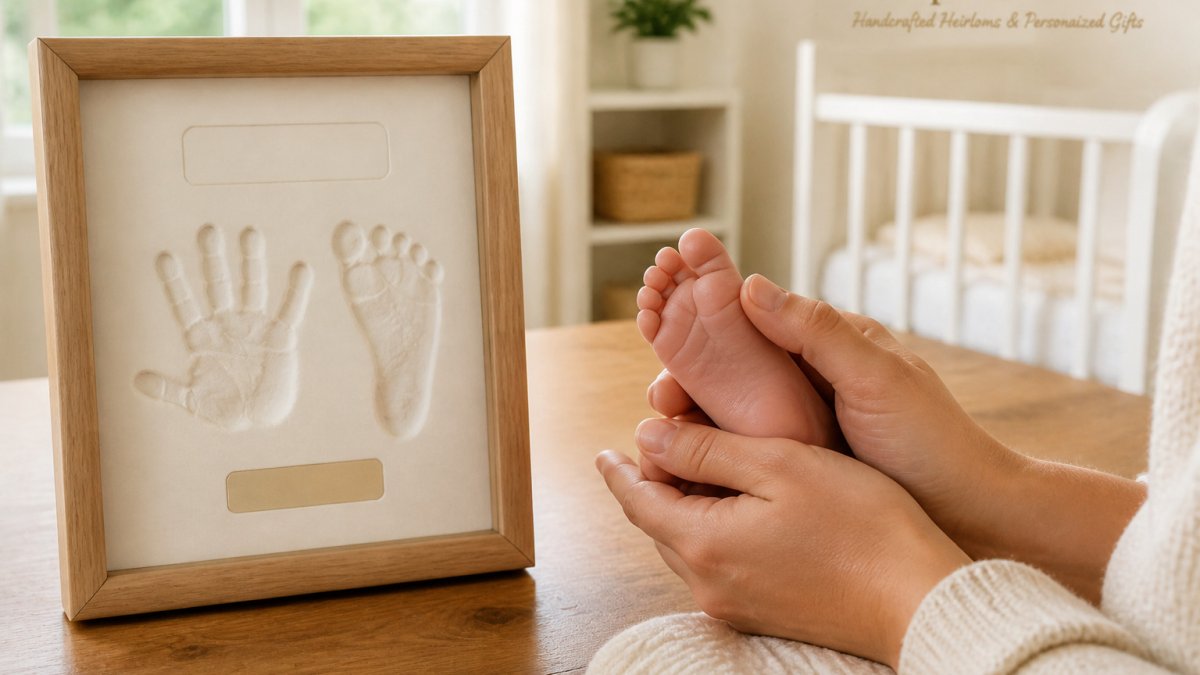
When making prints, use non-toxic ink and take the prints when the baby is calm and dry. Keep a backup photo of the finished print in case the original fades or is damaged.
Personalization Ideas by Budget, Effort and Keepsake Type
Matching the keepsake to your budget and time keeps the project manageable. The table below summarizes the options in this guide.
| Keepsake | Starting Price | Effort | Best For |
|---|---|---|---|
| Heirloom Woven Blanket | $59.99 | Low | Gifting and nursery display |
| Acrylic Square Plaque | $39.95 | Low | Shelf or nursery display |
| Custom Name Necklace | $39.95 | Low | Parents and grandparents |
| Gift Wrap with Personalized Message | $7.95 | Low | Adding a handwritten note |
| DIY clay or framed print | Varies | High | Hands-on parents |
Gift wrap with a personalized message costs $7.95 and works well alongside any of the items above when you want to add a handwritten note.
Watch out: Confirm every character before checkout, since custom items are made to order.
Choosing Your Next Personalized Keepsake From Keepsake & Co.
Pick the keepsake that matches the time you have and the story you want to tell. A woven blanket suits a gift, a plaque suits a nursery shelf, and a necklace suits a parent or grandparent who wears jewelry every day.
At Keepsake & Co., most of our products are designed, assembled, and shipped from our USA factory, and each order is packaged ready for gifting. Browse the full collection and find the piece that fits your family.
Frequently Asked Questions
What are some meaningful keepsakes to make for a baby?
Meaningful baby keepsakes include a name blanket, a framed birth-date print, a handprint or footprint impression, and a memory box filled with the hospital bracelet, first card and a lock of hair. Choose one or two pieces that match your budget and how you plan to display or store them.
How can I personalize a baby keepsake besides adding a name?
Beyond a name, you can add the birth date, weight and length, a short special message, or a nursery rhyme line that matches the baby's personality. A photo printed on acrylic is one option. A handwritten note tucked inside a memory box adds a personal layer that a printed design cannot replace.
What details should I include on a personalized baby gift?
Include the baby's full name as it appears on the birth certificate, the birth date, and optionally the time and weight. Choose a short message that feels true to your family, such as a welcome line or a wish for the future. Double-check spelling before ordering, since custom pieces are made to order.
How do you preserve a baby's handprint or footprint?
Use a non-toxic clay labeled for craft use, and press the hands or feet gently while the baby is calm. Let the impression air-dry fully before framing or sealing it under glass. Keep the finished piece away from direct sunlight and humidity to protect it over the years.


