


Table of Contents
- Why Picking the Right Family Keepsakes Matters
- Criteria for Choosing What to Keep
- Best Family Keepsakes to Pass Down
- How to Preserve Family Heirlooms
- Organizing and Displaying Your Keepsakes
- Meaningful Gift Ideas for Family Members
- Handling Family Conflict and Downsizing
- Passing Down Your Keepsakes to the Next Generation
- Frequently Asked Questions
Last Updated: September 22, 2026
Why Picking the Right Family Keepsakes Matters
Choosing which family keepsakes to preserve determines what stories survive, what values get passed forward, and which moments your grandchildren will hold decades from now. Meaningful family keepsakes are emotional anchors that connect generations.
Without a clear framework for deciding what truly matters, families end up preserving clutter instead of legacy. The goal is to keep the right things, not everything.
This guide covers how to identify, preserve, and pass down meaningful family keepsakes, including criteria that separate genuine heirlooms from guilt-driven clutter, preservation methods, and navigating family disagreements during downsizing.
Criteria for Choosing What to Keep
Not every family item deserves shelf space in your home or a place in your legacy. The best approach is to evaluate each potential keepsake against two core questions: Does this piece carry genuine emotional weight? And will it actually survive to tell its story?
Assess emotional attachment and provenance
Ask yourself: Does this keepsake connect you to someone you love or remind you of a specific moment that shaped who you are? Or are you keeping it out of guilt?
Real emotional attachment is specific: you can articulate why the item matters. You remember wearing your grandmother's engraved jewelry when you needed confidence, or rereading your parent's letters during difficult times. Those are keepsakes worth preserving.
Provenance, understanding where something came from and who owned it, adds depth to sentimental value. A piece of jewelry becomes an heirloom when you know which ancestor owned it and why it mattered. Letters gain power with context. Photographs become family history when labeled with names, dates, and relationships.
Evaluate condition and longevity
Before keeping a keepsake, assess whether it can realistically survive another generation or two.
Warning signs include yellowing pages, fading photographs, broken jewelry, stained textiles, and water-damaged documents. These require active preservation care, not passive storage.
Acid-free materials, natural fiber storage, and archival paper extend longevity. The best meaningful family keepsakes are ones you can realistically maintain.
Ask yourself: Am I willing to invest in proper preservation for this item? If the answer is no, it may not be a keepsake worth keeping.
Best Family Keepsakes to Pass Down
Certain categories of items naturally become meaningful family keepsakes because they combine emotional resonance with longevity. These are the pieces that families return to generation after generation.
Hand-written letters and documents
Hand-written letters capture voice in a way nothing else does. Reading a parent's letter decades later feels like hearing them speak again.
Letters work as meaningful family keepsakes because they're irreplaceable and document specific moments and relationships. Love letters, wartime correspondence, and notes from parents become treasured pieces of family legacy.
Birth certificates, marriage licenses, and naturalization papers are genealogically invaluable. Keep originals or high-quality copies to ensure family history is documented.
Store letters and documents in acid-free folders in cool, dry conditions with minimal handling. Digital preservation through scanning creates essential backups.
Engraved jewelry and heirlooms
Jewelry carries aesthetic beauty, material value, and personal history. Engraved jewelry becomes a message across time.
Engraved jewelry becomes a tangible connection to its wearer. Your grandmother's engraved watch is a physical link to her life and everyone who inherited it.
Jewelry works well as meaningful family keepsakes because it's durable, wearable, and portable, it can be worn and enjoyed, not just stored.
Store jewelry in individual compartments away from direct sunlight. For valuable pieces, use climate-controlled storage or a safe deposit box.
Photographs and memory boxes
Photographs are universal meaningful family keepsakes that freeze moments in time and connect you to ancestors you never met.
Memory boxes, curated collections of photographs, letters, jewelry, and mementos, create tangible representations of relationships or life chapters. These boxes become heirlooms passed down as complete narratives.
Life is Better With You - Heirloom →
Scan photographs at high resolution to create permanent backups. Label with names, dates, and relationships while you know the context, future generations won't be able to guess.
Store memory boxes in archival-quality acid-free containers in climate-controlled environments. Avoid plastic, rubber bands, and paper clips.
How to Preserve Family Heirlooms
Once you've decided which items deserve to be meaningful family keepsakes, preservation becomes your responsibility. The goal is to maintain these pieces so they can be passed down intact.
Archival storage and acid-free materials
The materials you use to store keepsakes matter as much as the keepsakes themselves. Acid-free storage prevents inevitable deterioration.
Standard paper, cardboard, and plastic containers contain acids that cause yellowing and brittleness. Acid-free alternatives prevent this damage.
Use acid-free boxes, folders, and tissue paper. Store items in individual compartments. Avoid plastic and basements. Keep storage cool, dry, and stable. Store textiles flat in dark locations.
Digital preservation of physical keepsakes
Digital preservation creates backups ensuring memories survive if physical items are lost, damaged, or stolen.
Scan documents and letters at high resolution. Store digital files in multiple locations: external hard drive, cloud storage, and a second drive in a different location.
Label digital files with dates, names, and relationships. Create a spreadsheet documenting each keepsake, its owner, significance, and digital location.
Digital preservation complements physical preservation. Together, these approaches ensure meaningful family keepsakes survive in one form or another.
Organizing and Displaying Your Keepsakes
How you organize and display meaningful family keepsakes affects both their preservation and their accessibility. The goal is to create a system where items are protected but also visible and present in family life.
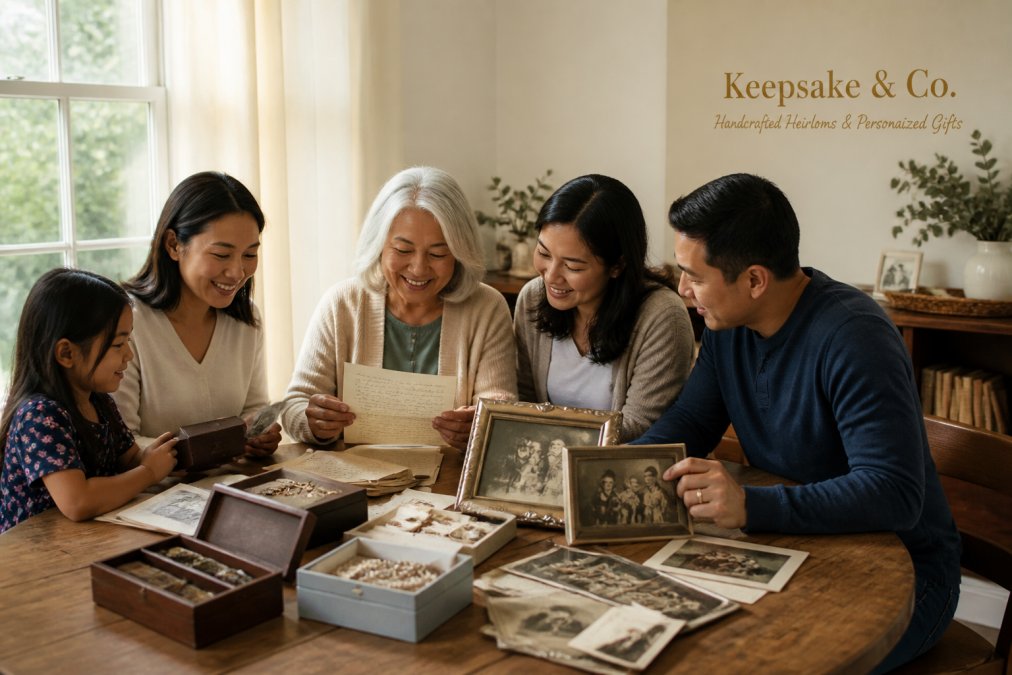
Start by categorizing your keepsakes. Group by person (all of Grandma's items together), by type (all photographs in one area, all jewelry in another), or by generation (items from your parents, items from their parents, and so on). The system that works depends on your family structure and what makes sense to you.
Rotate displays to keep items visible while limiting light exposure. Create curated collections in frames or shadow boxes.
Meaningful Gift Ideas for Family Members
Creating new meaningful family keepsakes is as important as preserving old ones. Thoughtful gifts designed to become heirlooms give future generations new stories.
Creating custom keepsakes for milestones
Milestone moments, graduations, weddings, births, anniversaries, are perfect opportunities to create keepsakes treasured for decades.
Personalized heirlooms that tell your story
The most meaningful family keepsakes reflect your specific family, values, and relationships. Generic gifts don't carry the same weight as intentional items.
Handling Family Conflict and Downsizing
Choosing meaningful family keepsakes often involves disagreement. Siblings may disagree about what to keep. Adult children may have different attachments. Partners may have conflicting values.
Passing Down Your Keepsakes to the Next Generation
The ultimate purpose of preserving meaningful family keepsakes is to pass them forward with intentionality about context, documentation, and stories.
| Keepsake Type | Best Preservation Method | Why It Matters | Passing Down |
|---|---|---|---|
| Hand-written letters | Acid-free folders, cool dry storage, digital scans | Captures voice and personality across generations | Include context about who wrote them and when |
| Engraved jewelry | Individual acid-free sleeves, safe deposit box or climate-controlled storage | Durable and wearable, accumulates meaning with each wearer | Document the engraving and its significance |
| Photographs | High-resolution scans, archival-quality storage, labeled with names and dates | Visual connection to ancestors and family moments | Create digital copies and label with context |
| Memory boxes | Acid-free containers, stable temperature and humidity | Curated narrative of a relationship or life chapter | Include a guide explaining what's in the box and why |
| Custom keepsakes | Display or archival storage depending on material | Created with intention for specific moments | Explain the occasion and who created it |
Frequently Asked Questions
What is the difference between an heirloom and a keepsake?
An heirloom is typically an item passed down through generations, often with monetary or historical value tied to your family's ancestral legacy. A keepsake is any meaningful object that holds emotional attachment or personal significance, it doesn't need to be old or valuable. Both serve as tangible memories, but keepsakes focus on emotional connection while heirlooms emphasize generational continuity and provenance.
How do I decide which family items are worth keeping as meaningful family keepsakes?
Ask yourself: Does this item trigger a specific memory or emotion? Does it represent someone important to me or a significant moment? Will it matter to my children or grandchildren? Consider the condition and whether it can be preserved long-term. Items with clear provenance, hand-written notes, engraved details, or photos attached carry stronger meaning. If an item doesn't answer 'yes' to at least one of these questions, it may not be worth the storage space.
What are some creative ways to display family keepsakes?
Create a memory wall with framed photographs and hand-written letters. Use shadow boxes for delicate items like jewelry or engraved pieces. Design a curated collection on floating shelves grouped by theme or person. Consider custom woven blankets featuring family artwork or meaningful quotes, these turn keepsakes into functional decor. Rotating displays keep items fresh while protecting them from constant light exposure. Memory boxes stored in a designated cabinet work well for items you want to preserve but don't display daily.
How can I preserve family heirlooms so they last for future generations?
Store items in acid-free boxes or archival-quality containers away from direct sunlight, moisture, and extreme temperature changes. Hand-written letters and documents benefit from acid-free sleeves. Photographs should be kept in acid-free albums or boxes. Create digital backups of photographs and documents. For delicate textiles, wrap in acid-free tissue. Consider professional appraisal and insurance for valuable heirlooms. Label items with their provenance and the person they belonged to so future generations understand their significance.


