


Table of Contents
- The Psychology of Gift Giving: Why Thoughtfulness Creates Emotional Connection
- The Benefits of Personalized Gifts: Emotional Resonance and Lasting Impressions
- Why Customization Increases Perceived Value and Recipient Satisfaction
- Personalized Gift Ideas for Her: Thoughtful Keepsakes for Milestones
- The Over-Personalization Threshold: When Customization Backfires
- Cultural Differences in Gifting and the Rise of Sustainable Personalization
- Frequently Asked Questions
Last Updated: September 14, 2026
The Psychology of Gift Giving: Why Thoughtfulness Creates Emotional Connection
Why do personalized gifts feel more special than anything you can pull off a shelf? The answer sits in how the human brain assigns value to effort. Gift-giving psychology research consistently points to one conclusion: recipients don't just evaluate what a gift is, they evaluate what it cost the giver in time, attention, and intention. This guide from Keepsake & Co. breaks down the actual mechanisms behind that feeling, from effort-based value to the neuroscience of receiving, so you can choose gifts that land the way you hope they will.
A personalized gift is an item altered or created specifically for one recipient, carrying their name, a meaningful date, or a detail unique to them. That specificity is the entire point.
Here's the throughline for everything below: personalization works because it converts an object into evidence. Evidence that you paid attention, that you remembered, that the recipient occupies a specific and irreplaceable place in your life. The mechanism is real, it's measurable in how people describe gifts they treasure, and it has limits most guides never mention.
Effort-Based Value: How Customization Signals Care
Effort-based value is the principle that people assign more worth to outcomes they believe required greater investment from the giver. A mass-produced item communicates convenience. A custom item communicates deliberation.

The distinction matters because thoughtfulness is not a feeling the giver has. It's a signal the recipient decodes. When someone unwraps a necklace engraved with their name, the message they receive isn't "this cost money." It's "someone sat down, chose this, typed my name into a form, and waited for it to arrive."
That chain of small decisions is the gift inside the gift.
The Benefits of Personalized Gifts: Emotional Resonance and Lasting Impressions
The benefits of personalized gifts show up long after the wrapping paper is gone. A generic item gets used and forgotten. A custom item gets kept, displayed, and shown to other people.
Emotional resonance is what happens when an object triggers a specific memory rather than a general pleasant feeling. A blanket woven with a couple's names and wedding date does more than keep someone warm. It reactivates the day itself.
Consider what a personalized gift accomplishes that a standard one cannot:
- It signals appreciation in a form the recipient can physically hold
- It creates a lasting impression because it cannot be replicated for anyone else
- It strengthens the interpersonal bond by making the relationship visible in an object
- It carries sentimental value that typically increases over time rather than depreciating
The last point is the one most gift-givers underestimate. Mass-market goods lose appeal as they age. Keepsakes tend to gain it.
Memory Formation and the Neuroscience of Gift Receiving
Most articles wave at "psychology" and move on. Here is what is actually happening in the recipient's head, in plain terms.
Gift receiving engages two systems at once: the mesolimbic reward pathway, which runs on dopamine and answers the question "is this good for me?", and the hippocampus, which decides what gets written into long-term memory. Dopamine does not deliver pleasure so much as it delivers salience, a chemical flag that says "pay attention, this matters." When a gift carries a personal detail, the reward signal and the memory signal fire together, and the hippocampus tags the moment for durable storage. That is why people can describe a meaningful gift from twenty years ago in detail but cannot recall what they got last December.
A second mechanism is self-referential encoding. The brain processes information tied to the self more deeply than information that is not. A gift with the recipient's name, birth year, or a private nickname routes through that self-referential channel automatically. The recipient is not just looking at an object, they are looking at a version of themselves reflected back. This is the closest thing gift-giving has to a cheat code, and it is why a $40 engraved item can outperform a $400 generic one on the metric that actually matters: how often the recipient thinks about it.
A third piece is anticipatory reward. The brain releases dopamine not only when a reward arrives but in the moments before, which is why the unwrapping matters as much as the object. A personalized gift extends that anticipation because the recipient can sense, even before opening, that something was made specifically for them.
Why Customization Increases Perceived Value and Recipient Satisfaction
Customization raises perceived value because it shifts the comparison. A generic item competes against every similar item on the market. A custom item competes against nothing, because there is no equivalent.
This is where cognitive bias works in the giver's favor. People consistently overvalue things they perceive as rare or uniquely theirs. Personalization manufactures that rarity honestly.
Recipient satisfaction follows the same logic. A person who receives something made for them reports a different kind of pleasure than someone who receives something merely expensive. The first is about being seen. The second is about being funded.
What most gift guides miss is that these are not competing goals. The best personalized gifts are both well-made and specific. Quality earns the object a place in daily life. Specificity earns it a place in memory.
A Harvard Business Review analysis of personalization in consumer psychology explores how tailored experiences shape satisfaction differently than generic ones, and the pattern holds for physical gifts as much as digital experiences.
Personalized Gift Ideas for Her: Thoughtful Keepsakes for Milestones
The best personalized gift ideas for her are the ones tied to a milestone she'll want to revisit: an anniversary, a graduation, a first Mother's Day, a decade of friendship. The gift becomes a marker for the moment.
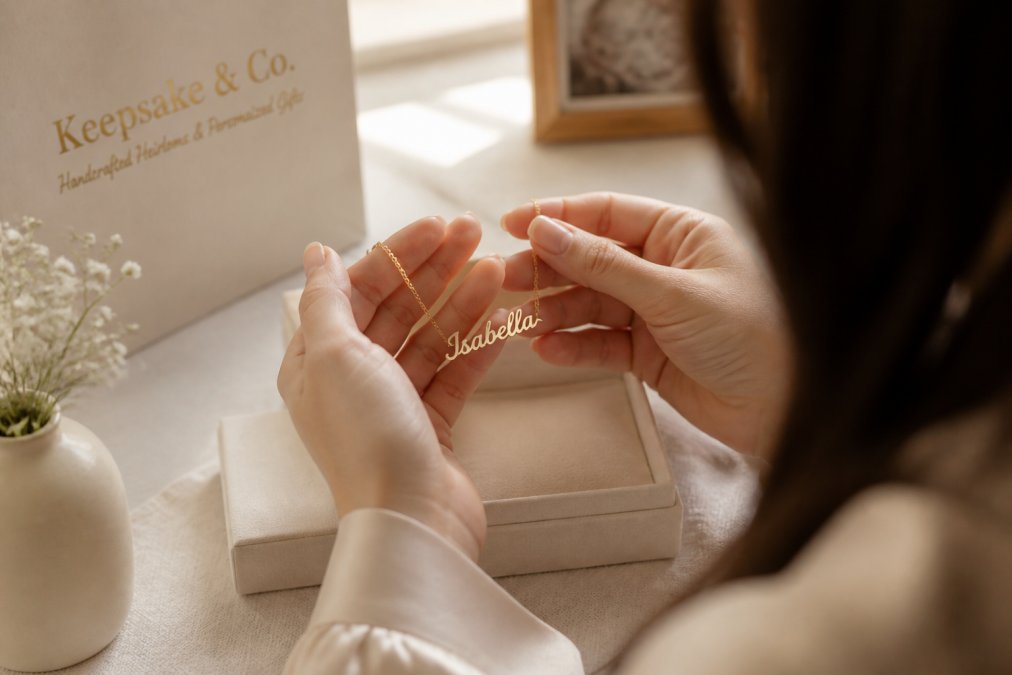
Three categories consistently outperform everything else for milestone gifting:
- Custom jewelry, because it's worn rather than stored, so the reminder travels with her
- Heirloom textiles, because they're used daily and become part of the home's fabric, literally
- Written keepsakes, because a journal or letter carries the giver's actual voice
Keepsake & Co. offers a classic name necklace engraved with up to ten characters, a woven cotton heirloom blanket, and a leather journal designed for personal notes and goal-setting. Most of our products are designed, assembled, and shipped from a small USA-based operation, which matters if you care who made the thing you're giving.

Choosing a Gift That Reflects Her Unique Identity
Unique identity is the target. The question isn't "what does she like?" It's "what does she like that almost nobody else knows about her?"
A gift that reflects a private detail, the nickname only you use, the city she left but still misses, the year things changed, proves a level of attention that a store-bought item simply cannot fake. That proof is the gift.
The Over-Personalization Threshold: When Customization Backfires
There is a point where personalization stops feeling thoughtful and starts feeling like a performance. Cross it, and the gift reads as an attempt to manufacture emotion rather than express it.
The over-personalization threshold is the line where the recipient senses more effort went into the gesture than into understanding them. Signs you've crossed it:
- The personalization references something the recipient never cared much about
- The item is so specific it has no use beyond display
- The message is longer or more intense than the relationship's actual register
- The gift seems designed to impress observers rather than the recipient
The fix is restraint. One meaningful detail beats five decorative ones. A single engraved date carries more weight than a paragraph of engraved sentiment, because the recipient has to do less work to feel it.
Cultural Differences in Gifting and the Rise of Sustainable Personalization
Gifting norms vary widely, and the same personalized item can read as deeply thoughtful in one context and slightly awkward in another. In some traditions, the presentation and ritual of giving carries most of the meaning. In others, the object's usefulness is the primary signal. In others still, the appropriateness of the gift relative to the relationship's closeness matters more than the gift itself.
Reading those norms correctly is part of the skill. A highly intimate keepsake given too early in a relationship can land differently than the same item given after a decade together. A few patterns worth knowing:
- Ritual-forward traditions treat the act of giving as the gift. A personalized item works here only if it fits the ritual, the wrong object can interrupt the ceremony rather than enhance it.
- Utility-forward traditions read personalization as a bonus, not a substitute. If the item is not useful, the engraving does not rescue it.
- Reciprocity-sensitive contexts can make an overly elaborate personalized gift feel like a debt. The recipient may feel obligated to match it, which turns a kindness into a burden.
- Modesty norms in some settings mean a loud, monogrammed item reads as showing off. Subtle personalization, an inside-lid engraving, a single initial, lands better than a name across the front.
The practical takeaway: personalization is not universally read as thoughtfulness. It is read as thoughtfulness when it fits the relationship's register. That is the same over-personalization threshold from the previous section, applied across cultural context rather than within a single relationship.
Sustainable Personalization: The Case for Fewer, Better Objects
Sustainable personalization is the newer shift, and it is a genuine improvement over the old model, but it deserves a more honest look than most gift guides give it.
The core argument is simple: custom items are inherently less disposable. Nobody throws away something with their own name on it. That means fewer replacements, less waste, and objects that stay in a household for years rather than seasons. A mass-produced novelty item is often discarded within a year; a personalized keepsake tends to become part of the furniture of someone's life.
But there are real trade-offs, and pretending otherwise is how gift guides lose credibility:
- Custom production is not automatically greener. One-off manufacturing can use more energy per unit than a high-volume production line. The environmental win comes from longevity, not from the act of customizing.
- Materials matter more than the personalization. A custom item made from virgin plastic and shipped across an ocean is not a sustainability story. A custom item made from durable natural fiber and shipped domestically is.
- The rebound effect is real. If personalization makes people buy more gifts rather than better ones, the net impact can be worse. The goal is substitution, not addition.
For gift-givers who care about where things come from, domestic production adds a second layer. A U.S. Small Business Administration overview of small business impact outlines how locally made goods circulate value differently than imported mass production. And a Federal Trade Commission guide to environmental marketing claims is worth reading before you take any retailer's "sustainable" label at face value, the agency publishes guidance on what those claims are actually allowed to mean.
Frequently Asked Questions
Why do personalized gifts have a higher emotional value than generic items?
Personalized gifts carry higher emotional value because they signal effort and thoughtfulness. When a gift is customized, the recipient sees that the giver paid attention to their unique identity, preferences, or shared memories. This effort-based value triggers feelings of appreciation and strengthens the interpersonal bond. Unlike generic items, personalized gifts become lasting keepsakes that hold sentimental value and create emotional resonance every time they are seen or used.
What is the psychology behind personalized gift-giving?
The psychology of gift giving centers on emotional connection and social signaling. Customization demonstrates that the giver invested time and consideration, which recipients interpret as a sign of intimacy and care. This process activates cognitive biases like the effort heuristic, where perceived effort increases perceived value. Personalized gifts also support relationship maintenance by creating a tailored experience that acknowledges the recipient's unique identity and milestones.
How does customization impact the perceived value of a gift?
Customization boosts perceived value by making the gift feel exclusive and tailored to the recipient. When an item is bespoke or curated, it carries a personal touch that generic products lack. This increases recipient satisfaction and gratitude because the gift reflects thoughtfulness rather than convenience. The psychological impact is so strong that even simple items, like a custom name necklace or a personalized journal, can feel more meaningful than expensive off-the-shelf alternatives.
Are personalized gifts considered more thoughtful than generic ones?
Yes, personalized gifts are widely considered more thoughtful because they require the giver to consider the recipient's personality, interests, and memories. This effort signals appreciation and emotional connection. Research on gift-giving psychology shows that recipients often value the thought behind a gift more than its price tag. A customized keepsake, such as a woven heirloom blanket or a leather journal with a personal message, demonstrates that the giver sees the recipient as an individual, not just a gift exchange obligation.


